Exploring the cultural, historical and personal connections of the San José Galleon: Colombian ocean heritage
- Sep 28, 2025
- 6 min read
Updated: Oct 1, 2025
Written by Carlos Del Cairo Hurtado and Carlos Reina Martínez, Archaeologists from Instituto Colombiano de Antropologíá e Historia (ICANH), Jesús Aldana Mendoza, Archaeologist, Saúl Vallejo Quintero, Oceanographer from Dirección General Marítima (DIMAR), and Hermann León Rincón, Oceanographer from Armada Nacional de Colombia (ARC).
The night of June 8, 1708 marked a radical change in Colombian history territory and maritorium. The sinking of the San José Galleon during the Battle of Barú (Cartagena de Indias), in which the English and Spanish faced off, was a heavy blow to both sides. Neither side was able to bring the famous booty back to the Iberian Peninsula or conquer it for the British Crown. A great deal has been written from a historical perspective about the War of the Spanish Succession (1701–1713) Triggered by the rise of the Spanish monarchy under Felipe V, a member of the Bourbon Dynasty and nephew of Luis XIV (King of France). As a result, England, Portugal, the Netherlands, and other powers feared that a dynastic union would upset the socio-political and military balance of power in Europe. Many publications have also been made regarding the development of the confrontation (June 8–12, 1708) and the bilateral consequences of the naval battle, which had repercussions for many years afterward. Here, we want to focus on something a little bit different.
From the moment it sank, the San José Galleon naturally aroused considerable interest among many different actors and sectors. In July 1985, the renowned Colombian writer Gabriel García Márquez recounted the fate of the Galleon and all the interest surrounding this particular shipwreck in his famous work "El Amor en los Tiempos del Cólera". In the reflection he discusses the story of the Galleon and the fact it may not be the only one at the bottom of the coral reef. In fact, it was the main flagship of the Tierra Firme fleet. Garcia Marquez discusses the historical and cultural relevance of the San José Galleon in contemporary Colombia. Where the relationships with the Galleon have varied, combining passion, ambition, affection and in some cases animosity.
Cultural, Historical and Personal Connections of the San José Galleon
The historical relationship between humans and the sea remains difficult, if not impossible to question to this day. This bond is built on intangible relationships, knowledge, and practices, as well as the material objects used in the past that have been preserved to the present day. The San José Galleon shipwreck is a perfect example of this.
Today, 317 years later, we observe cannons, porcelain, ceramics, coins, bottles, and other artifacts reflecting past societies. These artifacts show what was important to the civilization of 1708 and demonstrate the social appropriation that exists nowadays in 2025.

For example, for scientists, it is the love for knowledge. For the Colombian and international public, it is discovering what we were three centuries ago. For local communities, it is rediscovering their identity. For treasure hunters, it is a basic ambition. Passions are diverse and complex. Some value generating new information with a scientific approach. Others appreciate the sociocultural significance of an archaeological piece 600 meters underground. Some simply detest the fact that the gold and silver down there cannot be sold. As can be seen, there are multiple inclinations and positions, as well as a variety of arguments.

One thing is certain: people and communities have forged a unique bond with the sea and its contents, dating back to the origins of humanity and the beginning of civilization as we know it today. This relationship manifests in tangible and intangible forms and becomes the stories, myths, and legends passed down from generation to generation.
Children grow up with these narratives, and as they grow older, they realize that many of them are true. The words of Gabriel García Márquez from 1985 still ring true today, as in 2015, the Colombian government finally located the famous shipwreck using its research platforms. This ship had been sought since the year it sank.
At that time, the main concern was finding and recovering the “treasure” for its “economic value.” What they did not know was that, 317 years later, the Galleon's true wealth would finally be discovered: its historical and cultural value, shaped by the personal connections that define us today. The Galleon is now reflected in artistic, poetic, narrative, journalistic, and experiential expressions, which provide a deeper understanding of the sea and our relationship with it. In short, it is an Ocean Heritage.

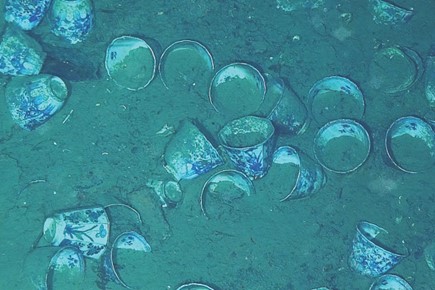

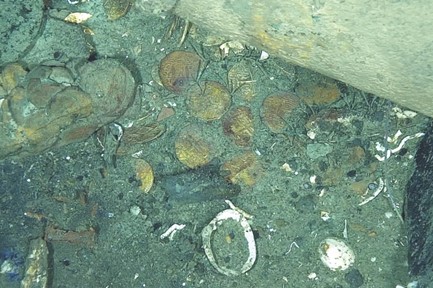
San Jose Galleon Chinese porcelain (right) and San Jose Galleon cobs (left) © ARC-DIMAR, 2022.
San José Galleon: Colombian Ocean Heritage
Examining the various connections, relationships, and passions inspired by the famous San José Galleon, it's clear that we're dealing with a truly unique Heritage. In Colombia, it has received several designations to protect it from individual or group ambitions. At different times and through various declarations for protection, it has been designated officially Underwater Cultural Heritage, Archaeological Heritage, Asset of Cultural Interest, and, most recently, a Protected Archaeological Area. Undoubtedly, it occupies a prominent place in Colombian history as Ocean Heritage.

So, given the importance of cultural heritage, we must protect it at all costs, safeguard it wherever possible, and preserve it for future generations due to several potential threats and hazards. We firmly believe that commercializing, storing, and reserving it for a select few is unjust. We must ensure that it remains shared cultural Heritage—yours, mine, and ours—where protection takes precedence over any individual or corporate interest in plundering it. Given this, the most obvious question arises: What should we do?
Since 2024, Colombia has been implementing an initiative unlike anything proposed in the local context before. This brought together two sectors that, in theory, are completely opposed to each other: Defence and Cultures. It turned out that the two sectors were not so different after all because the sea connects everything. This includes institutions, sectors, and disciplines that strive to protect the Ocean, its Culture, and its Heritage. For the first time in Colombian history, the Colombian Navy (ARC), the Colombian Institute of Anthropology and History (ICANH), the Maritime Authority (DIMAR), and the Ministry of Culture, Arts, and Knowledge collaborated on a joint study: the interdisciplinary scientific research project "Towards the Heart of the San José Galleon”.

What does the research aim to achieve? It seeks to record, document, analyze, understand, study, protect, safeguard, preserve, disseminate, publicize, raise awareness, and ultimately comprehensively manage the San José Galleon.
Fortunately, several institutions have joined forces to accomplish this challenging yet significant goal, including the Ministry of Science, Technology, and Innovation; the National Agency for Legal Defense of the State (ANDJE); and the Colombian Ocean Commission (CCO). Thanks to these institutions, multiple efforts have been coordinated and brought to fruition, allowing the public to learn about the project's progress and the results obtained to date. Data and products have been derived from the integration of various disciplines and areas of knowledge, including archaeology, conservation, anthropology, history, geography, law, oceanography, hydrography, geology, marine biology, systems engineering, and underwater robotics. Including an inter-institutional and cross-sector national strengthening, local technological innovation and capacity building, procedures for monitoring and protection in deep-water contexts, geostatistical analyses for the study of dispersion and distribution of the shipwreck, historical reconstruction of the battle, conservation protocols, biotic characterization, among others.
Based on these premises, these institutions and disciplines have managed to showcase their progress. After all, if what is done is not shared, it might as well not have been done. Is it worth putting in so much effort if only scientists and institutional leaders are aware of it?
We as interdisciplinary team don't believe that, Carlos D. as leader of the archaeological characterization component, Jesús as archaeological advisor to the Defense Sector, Hermann as Research Project Manager, Saúl as leader of the security component, and Carlos R. as leader of archaeological recording component.
Which is why we, and a bigger team, have created products that show to the world the true value and significance of the San José Galleon. These products highlight the cultural, historical, and personal connections of this unique Ocean Heritage site; from Colombia to the world:


Comments